HOLY FATHER POPE LEO XIV
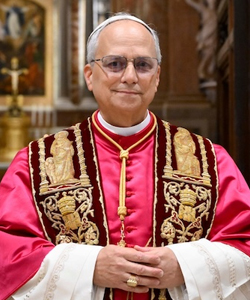
Holy Father Pope Leo XIV (born Robert Francis Prevost on September 14, 1955) is the 267th and current Pope of the Catholic Church and the first-ever American-born pontiff. He was elected on May 8, 2025, succeeding H.H. Pope Francis
Early Life and Education
Pope Leo XIV, born Robert Francis Prevost, grew up in a devout Catholic family near Chicago, Illinois. His parents instilled a strong sense of faith and service that shaped his future vocation.
Family Background
- Birth: Born on September 14, 1955, at Mercy Hospital in Chicago, Illinois.
- Parents: His father, Louis Marius Prevost, a U.S. Navy veteran and school superintendent, was of French and Italian descent. His mother, Mildred Agnes Prevost (née Martínez), a librarian and active parish member, was of Spanish and Louisiana Creole (African American) descent.
- Upbringing: He was raised in the suburb of Dolton, Illinois, and served as an altar boy at St. Mary of the Assumption parish. His family life emphasized prayer, including daily recitation of the rosary.
Education and Formation
His education prepared him for leadership within the Augustinian Order. He attended St. Augustine Seminary High School and later earned degrees from Villanova University (Mathematics, 1977) and the Catholic Theological Union in Chicago (Master of Divinity, 1982). He joined the Augustinian Order in 1977 and was ordained a priest in 1982. He pursued further studies in Rome, earning a Licentiate (1984) and a Doctorate in Canon Law (1987).
Missionary Work in Peru (1985–1999)
After completing his doctorate in Canon Law, Robert Francis Prevost joined the Augustinian mission in Peru in 1985. His time as "Padre Roberto" in Peru provided him with grassroots pastoral experience and deep immersion in Latin American Catholic life.
- Chulucanas (1985-1986): His first assignment was as chancellor of the Territorial Prelature of Chulucanas, where he also assisted the local bishop. Much of his early work focused on disaster relief following severe El Niño rainstorms.
-
Trujillo
(1988-1998): Prevost returned to Peru in 1988, spending a decade in Trujillo. During this period, he served in multiple capacities:
- Seminary Director and Professor: He headed the Augustinian seminary, teaching canon law, Patristics, and moral theology at the diocesan seminary.
- Parish Ministry: He worked as a parish priest in poor, outlying communities of the city, at parishes such as Our Lady Mother of the Church (later St. Rita Parish).
- Judicial Vicar: He served as a judge in the regional ecclesiastical court.
- Human Rights Advocacy: His years in Peru gave him personal knowledge of political violence and inequality. He was known for his defense of human rights and his criticism of government actions during the Fujimori era.
Augustinian Leadership (1999–2013)
In 1999, Prevost returned to the United States after being elected Prior Provincial of the Augustinian Province of Our Mother of Good Counsel in Chicago.
Two and a half years later, in 2001, he was elected Prior General of the entire Order of Saint Augustine, the global head of the order. He was based in Rome for this role, which he held for two consecutive six-year terms until 2013. This position required extensive international travel to the order's provinces and missions in nearly 50 countries, giving him a broad, global perspective on the Church. It was in this capacity that he first met Cardinal Jorge Mario Bergoglio (the future Pope Francis) in 2004 in Buenos Aires.
Episcopal Ministry in Peru (2014–2023)
After returning to the U.S. briefly in 2013, Prevost was appointed by Pope Francis in November 2014 as the Apostolic Administrator of the Diocese of Chiclayo in northern Peru.
- Episcopal Consecration: He was consecrated a bishop on December 12, 2014, at St. Mary's Cathedral in Chiclayo.
- Bishop of Chiclayo: In September 2015, he was formally named the Bishop of Chiclayo. Before this, as required by a diplomatic agreement between the Holy See and Peru, he became a naturalized Peruvian citizen, holding dual citizenship with the U.S..
- Pastoral Approach: Known to his community as "Padre Roberto", he developed a close bond with his diocese. He was widely regarded as a unifier and problem-solver, focusing on practical support for the poor, disaster relief, and advocating for human rights during a period of political tension.
- Additional Responsibilities: His leadership qualities were recognized by the Peruvian Bishops' Conference, where he served on the permanent council and led the Commission for Education and Culture. In 2020, Pope Francis also appointed him to temporarily oversee the troubled Diocese of Callao as Apostolic Administrator.
Service in the Roman Curia and Cardinalate (2023–2025)
Pope Francis brought Prevost to Rome in 2023 to assume a pivotal role in the universal Church's governance.
- Prefect of the Dicastery for Bishops: On January 30, 2023, Prevost was appointed Prefect of the Dicastery for Bishops and President of the Pontifical Commission for Latin America. This influential position placed him at the heart of the process for evaluating and recommending new bishops worldwide. He was known for incorporating broader input, including that of women, into the discernment process for episcopal candidates.
- Elevation to Cardinal: Pope Francis elevated him to the College of Cardinals on September 30, 2023, giving him the rank of Cardinal-Deacon. In February 2025, he was further promoted to the most senior rank of Cardinal-Bishop.
- Influence: His roles within the Curia and his ability to work across different factions within the Church gave him significant influence and visibility, positioning him as a respected figure with a global perspective leading into the conclave.
Papacy
Cardinal Prevost was elected Pope on May 8, 2025. He chose the name Leo XIV, honoring Pope Leo XIII and signaling a concern for workers. In his first address, he spoke of peace and dialogue and acknowledged Pope Francis. He resides in the Apostolic Palace and has an accessible papal style.